

California Adventure

Concept and Creation
The present-day site of Disney California Adventure was acquired by Walt Disney in the 1950s and functioned as the parking lot of Disneyland for over 40 years. After succeeding with the multi-park business model at Walt Disney World resort in Florida, the Disney company decided to turn Walt Disney’s original theme park into a multi-park resort complex as well. Disneyland was boxed-in, however, because of the growth of Anaheim around the park; while the Walt Disney World property was 30,000 acres at the time, the Disneyland site was about 400. This consisted of the park itself, the 100-acre parking lot, and the newly acquired Disneyland Hotel and vacation property from the Wrather Corporation. In 1991, Disney announced plans to build WestCOT, a west coast version of what was then known as EPCOT Center, on the site of Disneyland’s parking lot. The price tag of the proposed park was high and the company was facing financial and public relation problems with the newly opened Euro Disneyland (now Disneyland Paris). Additionally, Disney president Frank Wells died in a helicopter crash in 1994. These issues led Disney to cancel WestCOT in 1995.
In the summer of 1995, Michael Eisner, Disney’s CEO at the time, gathered company executives in Aspen, Colorado, to think of another idea for a second theme park in California. They broke down the Disneyland problem as follows: The majority of the people visiting Disneyland consisted primarily of California residents, locals, or those traveling from nearby states. Those who were visiting from another state or another country, probably had Disneyland as one of the several attractions to do in California. Based on this, Disney decided it would instead build a park themed to California’s history and culture to keep guests at the resort instead of going off-site. This would require less expensive hotels, a single parking garage, and very little additional property acquisition, with most of the park residing on the Disneyland parking lot. Then-Disneyland president Paul Pressler relied on merchandising and retail staff instead of Imagineers to design the park. As an adult-oriented park-like Epcot, dining, and shopping were the design focus. Construction of the park began on January 22, 1998. On Main Street, USA in Disneyland, a Disney’s California Adventure Preview Center opened in October 1998. The park’s construction was accompanied by Downtown Disney and Disney’s Grand Californian Hotel, in addition to renovation of the Disneyland Hotel and the re-theming of the Disneyland Pacific Hotel into Disney’s Paradise Pier Hotel (known today as Pixar Place Hotel).
Changes and expansion
Two major criticisms of the park in its first year were the lack of attractions appealing to children and the lack of a nighttime show or parade to keep visitors from leaving at nightfall. Within the first year of operation, Disney’s Electrical Parade was brought to the park (where it ran until 2010) as well as Who Wants to Be a Millionaire – Play It!, and several of the park’s original rides and attractions were closed, such as the stage show Disney’s Steps in Time and the Superstar Limo ride, which were closed in 2001 and 2002, respectively. During the 2001 holiday season, Disney’s LuminAria was presented on Paradise Bay. In October 2002, Flik’s Fun Fair opened as part of the new A Bug’s Land area, which added attractions for children, and in May 2004, The Twilight Zone Tower of Terror opened, with Who Wants to Be a Millionaire – Play It! closing in August 2004. The park also regularly featured seasonal promotions such as concert series, food festivals, and promotions for other Walt Disney Company franchises including the X Games and ABC soap operas. Monsters, Inc. Mike & Sulley to the Rescue! opened in the former Superstar Limo building in January 2006.
By 2007, Disney began making plans for major updates to the park. CEO Bob Iger said, “Any time you do something mediocre with your brand, that’s withdrawal. California Adventure was a brand withdrawal.” Iger briefly considered combining California Adventure and Disneyland Park into one large park, but the price would have cost as much as completely remodeling California Adventure.On October 17, 2007, the Walt Disney Company announced a multi-year, $1.1 billion redesign and expansion plan for Disney’s California Adventure Park (against its initial $600 million cost to build).[28][29] Each district was reimagined to transform the park from a spoof of modern California culture to a romanticized, idealized version of the state, exploring specific time periods and historic settings inspired by Disney and Pixar stories. The project began in December 2007 and was completed in stages. Toy Story Midway Mania! opened in Paradise Pier in June 2008, in space formerly occupied by a store and restaurants. World of Color, nighttime water and lights show on Paradise Bay, opened in June 2010. That same year, the park also received a modified name; Disney California Adventure. The Little Mermaid: Ariel’s Undersea Adventure opened on the site formerly occupied by the Golden Dreams theater in June 2011.
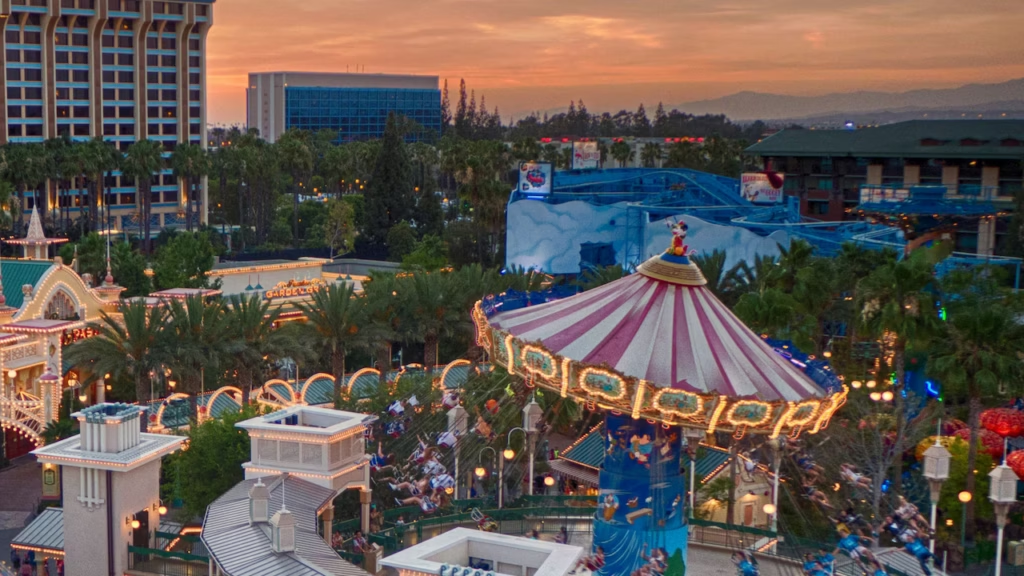
The most drastic changes to the park included a complete overhaul of the main entrance, Sunshine Plaza, and Paradise Pier and an expansion into the last of the parking area originally designated as future growth space for the park. The main entrance and Sunshine Plaza were changed from a giant postcard design into Buena Vista Street, a representation of Los Angeles as it appeared when Walt Disney moved there in the 1920s. The giant “California” letters in front of the turnstiles were removed and donated to Cal Expo in Sacramento. Paradise Pier was turned from a contemporary representation of California boardwalks into a representation of Victorian seaside amusement parks of the 1920s, and some of the area’s off-the-shelf rides were either removed outright, (such as Maliboomer), or re-themed to have more of a focus on Disney characters (such as Mickey’s Fun Wheel, Goofy’s Sky School, and Silly Symphony Swings). Cars Land, an area that recreates Radiator Springs from Pixar’s Cars franchise, was added to the southeast portion of the park and features three rides, including the E ticket Radiator Springs Racers. Construction was completed in 2012 and the park was then re-dedicated on June 15, 2012.
The redesign and expansion of the park saw attendance rates increase dramatically. In 2012, Disney California Adventure reached a record high for the park of over 7 million visitors (a 23% increase from the year before), a number Disney had hoped the park would attain in its first year. The day of the park’s rededication saw the park draw a record number of 43,000 visitors in one day. The night before the rededication, over 500 people camped outside of the park in order to be the first admitted in. Two days later, the park hit a new record of 45,000 visitors. In 2013, speaking on the attendance increase at Disney California Adventure, Jay Rasulo, then-Disney’s chief financial officer, said: “We had a very uneven distribution where most people spent most of their time at Disneyland and Disney’s California Adventure was empty. Now, half of the folks go to one, half of the folks go to the other. It’s almost a dream come true.”